

My big, beautiful backyard solar
How I became a "solar guerrilla" in four days. And my big, beautiful energy bill savings! Happy SUN Day.

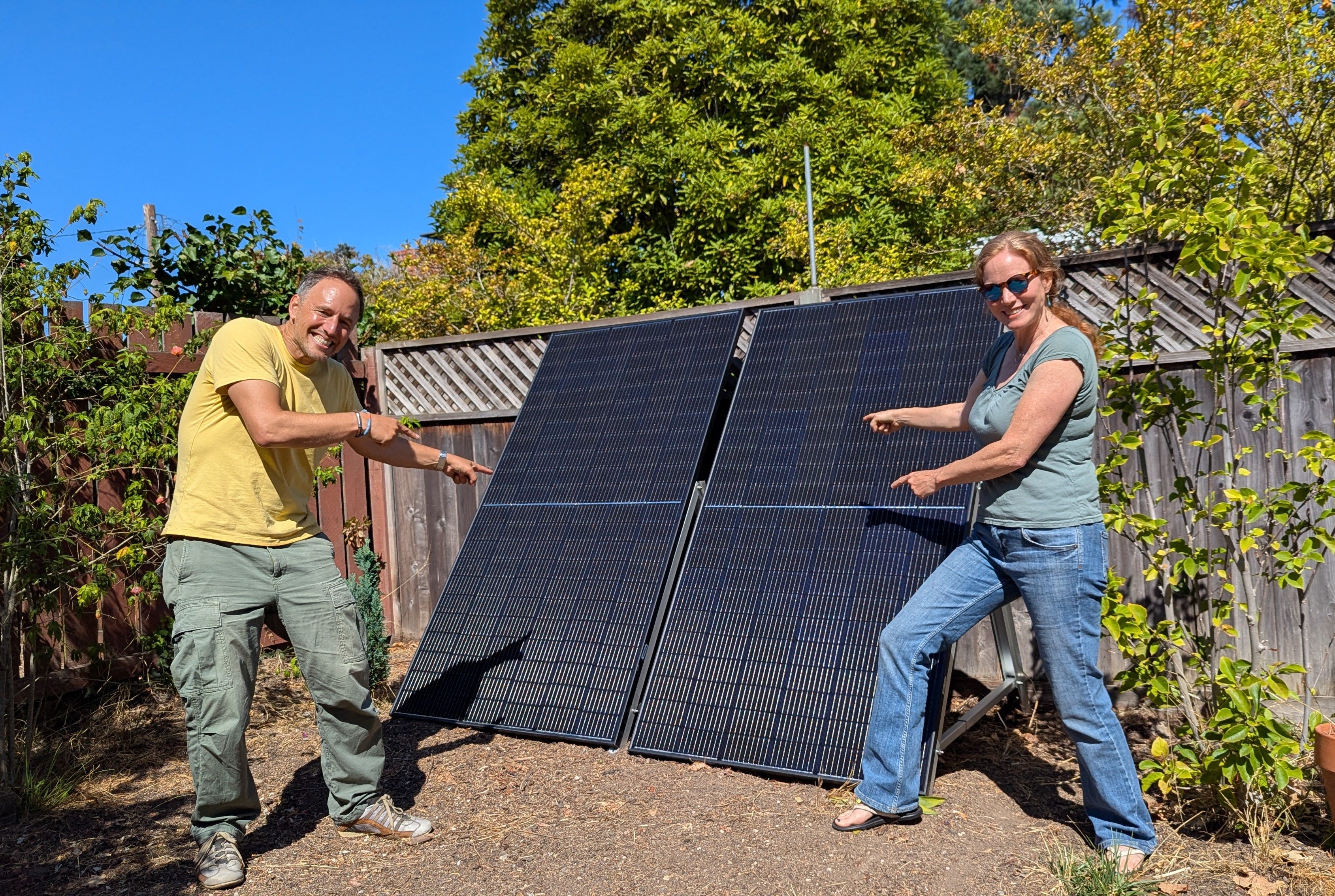
I’m not just a hope activist. As of Friday, I’m also a “solar guerrilla.”
Here’s why: I plugged two 400-watt panels into an outdoor outlet at our home without telling anybody.

I’m not feeding power back into the grid, so I didn’t need anyone’s permission to plug the system in. I’m reassured that it’s “not illegal,” but something about what I did is “grey area” in existing California law. There are simply no rules either way about it.
Hey, I’m a risk taker. I’m a rebel. I’m happy to occupy the grey area.

The money math
I’ve also volunteered to be part of solar startup Bright Saver’s pilot project to collect data on how much power and money I’ll be saving with the panels over the next year. This data will help them convince California policymakers and potential buyers that, well, PLUG-IN SOLAR IS A NO-BRAINER.
The setup — including panels, battery, home energy monitor, and sales tax — cost $2,600. If I include the 30 percent tax rebate for solar that expires at the end of the year, the system will pay for itself within three years. Without the tax rebate, it will take five years to pay off. After that, I could save another $7,500 over the lifespan of the panels. WAH, that’s a lot of my money I get to keep! I couldn’t pass that up. We rent and we won’t need this house forever, so when we move, we’ll take the panels with us.
That math is based on today’s electricity rates in California, already astronomical but sure to rise even more over the coming years. While the average cost per kWh in the U.S. is 17.5 cents, Pacific Gas & Electric charges 62.5 cents per kilowatt hour during peak use hours of 4 to 9 pm and 50 cents in off-peak hours. Gag! That’s three times the national average. We paid $1,633 for electricity for this home in 2024, and that’s without using air conditioning.
How easy is plug-in solar?
This easy:
I clicked “buy” on Monday on Bright Saver’s website.
The panels were installed four days later, on Friday.
Erecting the panels took 30 minutes.
The cord from the panels plugs directly into our home via an outdoor outlet. No electrician is required for this step.
The home energy monitor, a gadget that attaches to the breaker box, should be installed by an electrician. This step takes 30 minutes.
No permits, no paperwork. This is my system and my energy. PG&E’s jurisdiction stops at my meter.
The battery is as small as a small cooler, sits under the panels, and is portable.
Anyone with access to sunlight and a plug can do it: renters, homeowners, churches, schools, restaurants, RVers, etc.
It would have cost 30 percent more, and possibly months of delay, to get these same panels running on a roof.
“The combination of battery and energy monitor allows the system to optimize for self-consumption, saving the electricity produced during the sunny hours of the day for the evening, nighttime, and early morning, when the sun doesn't shine,” said Rupert Mayer with Bright Saver.
‘I’m just going to install my own system, hang it on my own balcony and PG&E never needs to know.’
My family and I are among only a couple dozen households in the San Francisco Bay Area to give plug-in solar a try. Compare that to Germany, where over one million people have plugged in small solar systems.
Nearby, a fellow solar guerrilla was recently featured on our local radio station, KQED:
[Matthew] Milner is one of the solar-curious, who are testing the waters by purchasing a small, portable, plug-in display.
“We’d wanted to get rooftop solar, but it’s so expensive,” said Milner, a scientist. The price of rooftop solar in California ranges widely and can cost tens of thousands of dollars. “This allows us to dip our toe in a little bit without having a huge financial cost and see how it works for us.” …
Bernadette del Chiaro, senior vice president for California at Environmental Working Group … said consumers are more likely to say: “‘I’m just going to install my own system, hang it on my own balcony and PG&E never needs to know.’”
A sticky issue about solar is that large systems must feed excess energy back into the grid. The economic benefits of rooftop solar depend on the utility buying that extra energy, a program called “net metering” that was recently under threat in California. Net metering requires permits and contracts with the utility. Battery storage has changed all of this.
Utah recently became the first state to “legalize” plug-in solar. The legislature unanimously passed a law defining “small portable solar generation devices” and allowing them to be exempt from permits. In short, a few plug-in panels that might occasionally feed minuscule amounts of extra power back into the grid are not to be bothered over by utilities. Activists hope Vermont will soon follow suit.
It’s crazy to think that in 2025 there’s anything “guerrilla” about this. I live in a state where the sun perpetually shines, but the power company charges insane prices for electricity. We’re a four-person household with a ton of laundry and dishes. My mom is disabled and lives in her own room with her own fridge, TV, heating, and fans. We’re guzzling energy all day, every day.
Yep, I’m going to hella occupy that grey area.
How it works:
The small battery stores any extra power generated by the panels.
The home energy monitor and battery are constantly talking to each other to decide how much energy to send to the home versus store in the battery. It’s a “‘zero export’ system that won't backfeed to the grid,” said Mayer.
The system does not allow more than 400 watts to enter the circuit, a safety feature.
The battery pairs with its own branded app to provide info on energy generation and storage.
The entire system, including battery, shuts down during any power outage, which ensures safety for utility workers fixing power lines.
“Let me tell you what happens when you start to feel momentum. You push harder.
“This is the tipping point we're pushing toward. When consumers adopt clean energy because it's the rational economic choice—when, as we project in our forthcoming white paper, average payback periods for plug-in solar fall below 3 years—North Americans will adopt it in the tens of millions.”
— Cora Stryker, co-founder, plug-in solar non-profit Bright Saver

Won’t you join me?
Today, September 21, is SUN Day, a day to share the benefits of solar and wind power. Ever since hearing about Bright Saver’s pilot about six months ago from Sam Matey-Coste and then again from Bill McKibben , I’ve been itching to try them. And for SUN Day, I didn’t want to just write about solar, I wanted to get some panels in my hands. When Bright Saver sent out an email last week that said, “Let me tell you what happens when you start to feel momentum. You push harder,” I was all in.
Won’t you join me? I want friends to join my guerrilla force!
Legacy media is ignoring just how much solar power is being deployed in the U.S. and across the planet, regardless of shifts in tariffs and subsidies.
Two thirds, or 67 percent, of California’s power comes from renewable and non-carbon (nuclear) energy sources.
Over 90 percent of new electricity generation in the U.S. will come from renewables in 2025.
China spent $625 billion on clean energy in 2024, leading the world in solar and wind investment, according to think tank Ember. Solar and wind deployment make up 10 percent of its economy, equivalent to the entire GDP of Australia. Don’t miss, from The New York Times: ‘China Is the Engine’ Driving Nations Away From Fossil Fuels, Report Says
Check out, from Hannah Ritchie: “Which countries are scaling solar and wind the fastest?” The answer depends on which metric you use.
Do you believe me now? There’s a lot to be hopeful about.
About Earth Hope:
Earth Hope is a solutions-based journalism project that highlights environmental success stories to inspire action. I’m Amanda Royal, a former newspaper reporter and current eco-news junkie. Read more about this project and what inspired it. Visit earthhope.substack.com for more stories. c